
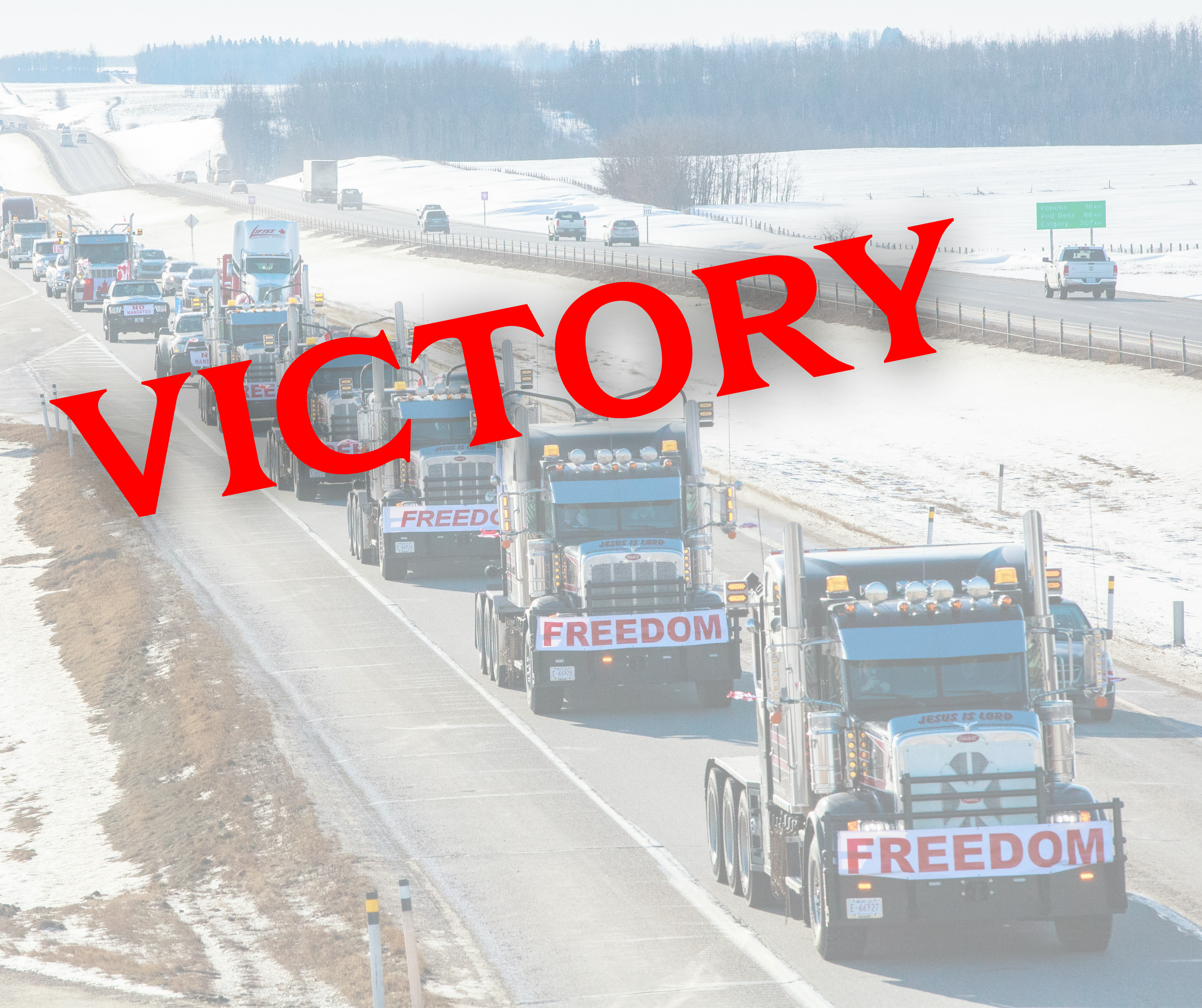
The Federal Court of Appeal has upheld the January 2024 ruling that the Trudeau government unlawfully invoked the Emergencies Act in response to the 2022 Freedom Convoy, and violated the Charter rights to freedom of expression and freedom of peaceful assembly.
The Court agreed with the Canadian Constitution Foundation that the government did not satisfy the strict legal threshold required to invoke the Emergencies Act, which allows the federal government extraordinary powers such as the ability to make criminal laws by executive order.
The Court also agreed with the CCF that the way the government froze bank accounts violated the right to security against unreasonable searches and seizures and that its de facto ban on travelling to or funding Freedom Convoy protests nationwide violated freedom of expression.
In fact, the Court accepted nearly ALL of the CCF’s arguments. This document answers some basic questions about the decision and highlights key passages that will inform the law for decades, if not centuries, to come.
Was Justin Trudeau’s decision to invoke the Emergencies Act a lawful decision?
No. The Court found the decision was not reasonable, and therefore it was unlawful.
This was for two reasons. The first was that it was unreasonable for the government to find there were “threats to the security of Canada.”
The second was that there was no “national” emergency. There was no emergency on a national scale that required the federal government to step in, rather than leaving the situation to the provinces and the existing laws.
Why did the Court find there were no “threats to the security of Canada?”
The 1988 Emergencies Act was a response by Parliament to the draconian suspension of civil liberties during the 1970 October Crisis, during which the War Measures Act had been used to detain people without cause and without the ability to go before a judge to have the legality of their detentions determined.
Section 17(1) of the Emergencies Act is designed to prevent abuse by requiring that, before Cabinet (here Cabinet delegated their decision to Prime Minister Justin Trudeau), can declare a “public order emergency,” they must “believe, on reasonable grounds, that a public order emergency exists and necessitates the taking of special temporary measures for dealing with the emergency.”
Section 16 defines a “public order emergency” as “an emergency that arises from threats to the security of Canada and that is so serious as to be a national emergency,” and provides that the phrase “threats to the security of Canada” has the meaning as it does in section 2 of the CSIS Act.
Under section 2 of the CSIS Act, there are several options for what can count as “threats to the security of Canada.” The one the government focused on was the threat of terrorism: “activities within or relating to Canada directed toward or in support of the threat or use of acts of serious violence against persons or property for the purpose of achieving a political, religious or ideological objective within Canada or a foreign state.”
The Court found the Trudeau government had not shown reasonable grounds to believe there was a threat of serious violence against persons or property. They had focused mostly on the threat of economic disruption or highly speculative claims of actual violence.
The Court noted that a threat assessment done by CSIS itself that had found no threat of serious violence should have been given weight. Here are some of the key passages:
[209] To that extent, we share the view of the Federal Court that it is up to Parliament to revisit the definition of “threats to the security of Canada” if it is of the view that it does not adequately cover the various types of harms that may result from an emergency situation, such as those of an economic nature. For the time being, we must take the Act as it reads, and not as the AGC would like it to read. It would stretch beyond rationality the meaning of the words “serious violence”, when applied to property, if they were to encompass purely economic consequences or speculative disruption of essential goods and services.
[212] Relying on the Section 58 Explanation, the AGC claims that there were considerable cumulative threats of serious violence to individuals, including the threat of lethal violence. Having carefully read that document, we agree with the Federal Court that there is very little hard evidence of any actual serious violence or threats of it, except at Coutts; otherwise, the Section 58 Explanation focuses mostly on the economic impact of the blockades, on speculation as to what might happen if the protests were not brought to an end, and on unsubstantiated and vague reports from unidentified sources.
[219] Of course, the CSIS assessment that there were no threats to the security of Canada was not determinative and could not bind Cabinet. The Federal Court and the respondents agree that the GIC was not limited to considering the intelligence collected by CSIS or by its analysis of that intelligence. Because of its expertise in investigating threats to the security of Canada, however, CSIS’s threat assessment should nevertheless have carried substantial weight; after all, it is one of CSIS’s principal activities to investigate, analyse, and retain information and intelligence on security threats: X(Re), 2016 FC 1105 at para. 159, citing the Pitfield Report at para. 28.
….
[231] As for the threat or use of acts of serious violence against persons, when properly understood as requiring bodily harm, the evidence is quite simply lacking. Aside from the economic disturbance, the only incident of violence put forward by the AGC was the seizure of a cache of firearms and ammunition at Coutts, as well as vague reports of harassment, intimidation, and assault, and the fact that the police forces in Ottawa were overwhelmed. In our view, this is insufficient to satisfy the compelling and credible information requirement to justify the conclusion that there were reasonable grounds to believe that there was a threat or use of acts of serious violence. Declaring a public order emergency is a very serious matter, considering the extraordinary powers vested in the executive branch of the federal government once the Act is invoked, and for that reason the exacting requirements set out by Parliament must be strictly adhered to.
[232] As disturbing and disruptive the blockades and the Convoy protests in Ottawa could be, they fell well short of a threat to national security. This was borne out by CSIS’s own threat assessment, and the fact that although an alternative threat assessment was requested, the GIC invoked the Act before it was completed is another critical factor.
Why did the Court find there was no “national” emergency?
The federal government can only invoke the Emergencies Act in a couple of situations, as per section 3 of the Act, in order to respect the constitutional division of powers between provinces and the federal government.
Section 3 defines a “national emergency” as an “urgent and critical situation of a temporary nature” that “seriously endangers the lives, health or safety of Canadians,” that “exceed[s] the capacity or authority of a province to deal with it” and that “cannot be effectively dealt with under any other law of Canada.”
The Court found that there was no “national” emergency. The only evidence of a serious threat of violence was in Coutts, Alberta (a single province), and that had been effectively dealt with under existing criminal laws before invocation. The problems in Ottawa were not a lack of “capacity or authority,” but the willingness of some members of the Ottawa Police Force to do their jobs.
Plus, Ontario could have called in the Ontario Provincial Police (as they subsequently did).
Hence, there was no national emergency. Here are some key passages:
[265] As troubling and concerning as the situation at Coutts may have been at the time, the record shows that it was effectively dealt with for all intents and purposes before the Proclamation, and there is no explanation as to how the Regulations enacted in its wake contributed in any way to restoring public order. The AGC’s claim that the effectiveness of existing laws is entirely speculative is therefore spurious; what is speculative is the AGC’s submission that the Criminal Code “riot” measures could have led to clashes between police, Convoy participants and counter-protesters. This is clearly not sufficient to meet the thresholds of a “national emergency” as defined in the Act and to suspend the federal nature of our Constitution.
[266] As for the situation prevailing in Ottawa, it appears from the Section 58 Explanation that the concern had more to do with leadership issues within the OPS and the willingness of some of its members to enforce the law. After noting that the Chief of the OPS resigned on February 15, 2022 “in response to criticism of the police’s response to the protests”, the Section 58 Explanation suggests that the main justification for the claim that there were no existing laws that could effectively deal with the emergency was a lack of resources:
In Ottawa, the Ottawa Police Service has been unable to enforce the rule of law in the downtown core due to the overwhelming volume of protesters and the Police’s ability to respond to other emergencies has been hampered by the flooding of Ottawa’s 911 hotline, including by individuals from outside Canada…
The inability of municipal and provincial authorities to enforce the law or control the protests may lead to further reduction in public confidence in police and other Canadian institutions.
AB, Vol. 1, Tab 5, pp. 211-213.
[267] This is a far cry from the requirement that there be no other law of Canada that could effectively be used to deal with a situation that endangers the lives, health or safety of Canadians. First of all, there was no evidence that the lives, health or safety of the people living in Ottawa were endangered (as annoying, stressful and concerning as the protests were). But more importantly, what was lacking to re-establish public order was not more legal tools beyond what was already available, but more policing resources. If the issue was that the OPS could not enforce the rule of law, new laws would not be helpful, and neither the Regulations nor the Economic Order provided for an increase in the operational capacity of the police, as noted by the Federal Court (at para. 231).
[271] This is not to say that the Act, along with the Regulations and the Economic Order adopted thereunder, was not convenient and did not provide helpful, effective tools to restore public order and bring back some normality to the chaotic and, at times, threatening situations that erupted in different corners of the country. However, this is not the test set out in the Act. To bring about a temporary suspension of the division of powers between Parliament and the provincial legislatures requires more than convenience, and the lack of any compelling explanation as to why Cabinet was of a contrary view only compounds the issue.
[286] In a federation, provinces should be left to determine for themselves how best to deal with a critical situation, especially when it largely calls for the application of the Criminal Code by police forces. The emergency power (and, with it, the suspension of the constitutional division of powers) cannot be employed to override a provincial government’s decision not to exercise its powers, or to exercise them in a manner that does not conform with the preferences of the federal government. To the extent that a situation is not of such proportions or nature as to exceed the capacity or authority of the provinces, they should be left to their own devices. Of course, the federal government could nevertheless issue a declaration of a public order emergency if the situation seriously threatens its ability to preserve the sovereignty, security and territorial integrity of Canada, pursuant to the second branch of the national emergency definition at section 3 of the Act.
Why did the Court find that freedom of expression was violated?
The Court found that the freedom of expression of protesters was violated for a few reasons.
Section 4(1) of the Regulations created as a result of the invocation prohibited “travelling to or within an area where an assembly…” that “may reasonably be expected to lead to a breach of the peace taking place,” and “directly or indirectly” making property (ie: money) available for the “purpose of benefiting any person who is facilitating or participating in such an activity.”
The Court agreed that these measures limited the freedom of expression protected by section 2(b) of the Charter of Rights and Freedoms and that these limits could not be upheld under section 1 of the Charter, meaning they violated constitutional rights.
This was because the Regulations were overbroad (not minimally impairing). They applied not only to those who broke the law by blockading but to people – under threat of $5,000 fines and up to five years in prison – engaged in peaceful protests, which is a form of expression. They could easily have been limited to those breaking the law. Adding insult to injury, they applied nationwide rather than to just where the protests were occurring.
Here are some key passages:
[349] By criminalizing entire protests, the Regulations did not just limit the right to freedom of expression of those who were engaged in activities that breached the peace. They also limited the right to freedom of expression of protestors who wanted to convey their dissatisfaction with Government policies in a peaceful, non-violent manner, who did not intend to participate in the blockades or otherwise disrupt the movement of traffic or the functioning of critical infrastructure, and who did not support the threat or use of acts of serious violence against persons or property. Such individuals were nevertheless violating section 2 of the Regulations through their simple presence at a public assembly where a breach of peace was happening or might reasonably have happened or might happen in the future. The purpose and effect of the Regulations were thus to restrict the freedom of expression of such individuals.
[350] The restriction on travel contained in section 4 of the Regulations was similarly overbroad, capturing individuals who simply walked over to a public assembly where others were disrupting the movement of traffic or otherwise disrupting the peace, even if the individual had no intention of helping or joining in with the disruption of movement. Once again, such individuals were subject to prosecution, even if all they wanted to do was to stand quietly on public property in solidarity with other protesters.
[351] Moreover, by prohibiting anyone from providing “property” to those participating in such a broadly defined “public assembly,” section 5 of the Regulations caught anyone who gave food or water to people standing peacefully on Parliament Hill while others were disrupting traffic or otherwise breaching the peace. It also caught anyone who donated funds in support of peaceable protesters who were adding their voices in support of the goals of the protests—clearly an expressive act.
[371] For example, the GIC would have known on February 15, 2022, that the geographic reach of the Regulations could have been limited to Ontario and Alberta, where protests had been most active. The Regulations could then have been amended to cover other jurisdictions in the future, if necessary. This is not a “hindsight driven” suggestion. The wording of the Emergencies Act specifically contemplates that public order emergencies do not need to be declared nationally, but can extend “only to a specified area of Canada”: subsection 19(2).
[372] Another way that the Regulations could have been made less impairing would have been to limit their application to those individuals actually disrupting the flow of traffic or otherwise behaving in a manner that could reasonably be expected to lead to a breach of the peace. The GIC could have created an exception within the Regulations for peaceable protesters.
[373] As discussed earlier, while the Regulations captured protesters who parked their trucks on Wellington Street and refused to move, disrupting the flow of traffic or who otherwise behaved in a manner that could reasonably be expected to lead to a breach of the peace, the Regulations also caught peaceable protesters. The Regulations were clearly not minimally impairing as they related to these individuals.
Why did the Court find the government violated the right to security against unreasonable search and seizure when it ordered banks to freeze accounts?
After invoking the Emergencies Act, the government issued an “Economic Order” that required financial institutions to disclose private financial information regarding “designated persons” to the RCMP or CSIS (section 5) and empowered governments or their institutions to disclose private information belonging to “designated persons” to financial institutions (section 6).
This led to egregious warrantless searches based on little more than a bare belief by police officers that a person may have violated the order.
The Court found that neither of these regulations properly safeguarded the right to security against unreasonable searches and seizures. Here are some key passages.
[452] The information-sharing provisions of the Economic Order permitted financial institutions, CSIS and the RCMP to intrude on the privacy of individuals based on potentially unfounded, subjective beliefs.
[458] These considerations lead inexorably to the conclusion that the information-sharing provisions of the Economic Order were unreasonable. Sections 5 and 6 of the Economic Order failed to strike a reasonable balance between the interests of the state and those of individuals subject to searches under the Economic Order, thereby infringing their section 8 rights.
[470] The most egregious problem with the Economic Order, in our view, is that personal banking information belonging to individuals who were suspected of having committed offences under the Regulations could be shared with the RCMP and CSIS without a warrant or any form of prior authorization, which information could well have provided evidence of offences under the Regulations.
[472] The risk of innocent individuals being wrongfully identified as “designated persons” could also have been reduced by ensuring that financial institutions had a reliable source of information regarding the activities of their customers, such that they were not expected to rely on news stories and the internet to decide whether their disclosure obligations had been triggered.
[473] There were other procedural safeguards that could have been included in the Economic Order to make it less impairing, including the satisfaction of a higher standard of suspicion as a prerequisite to information-sharing, and the creation of a review mechanism to allow affected individuals to challenge actions taken under the Economic Order. Another procedural safeguard would have required prior authorization before sharing confidential financial information with financial institutions, the RCMP, CSIS or local police.
What happens next?
The Government of Canada, with Prime Minister Mark Carney’s signoff, will decide whether to accept the Court’s decision or appeal to the Supreme Court of Canada. Then, it will be up to the Supreme Court to decide whether they want to hear the case.
If the government appeals and the Supreme Court decides to hear the case, the CCF will be there to fight for Canadians’ rights and freedoms.
If the Supreme Court of Canada refuses to hear the case, the Federal Court of Appeal’s decision will stand forever.